

At a glance
- A resumption in hostilities between the US and Iran has left the global economy in a more uncertain place.
- As events and their impacts are near impossible to predict, ensuring investment portfolios are prepared for multiple scenarios is key.
- Ultimately, the impact of big macro events on portfolio returns tends to fade in importance when looking over the longer term.
How do you make a financial plan, when the world is so uncertain? With the Iran-US conflict now in its sixth month, a flurry of reports of a possible peace deal, swiftly followed by a resumption in hostilities, have left investors baffled as to what happens next. With no sign of an end to the ‘on again, off again’ status, we look at how best to survive recent – and ongoing – volatility.
When the US and Israel first launched strikes on Iran in late February, the global economy faced a fresh bout of uncertainty. With its ability to potentially close all shipping through the Strait of Hormuz, a key transit route for a significant share of the world’s oil and fertiliser exports, there was an initial jump in energy prices.
There were widespread concerns about the impact of the conflict on price rises, particularly as inflation was already above its long-term target in numerous developed market economies.
Certainly, fuel prices increased, as could be seen in petrol station forecourts. However, by the time a memorandum of understanding (MOU) was signed in June, it seemed the worst-case scenario had been avoided, and oil prices settled from their initial peaks. Inflation had crept up in some markets, but not to the extent feared. The first phase of the conflict saw limited price rises, contained by individual country efforts to release reserves, increase supply from elsewhere and make modest demand reductions.
Noting the effects in the first half of the year, Preksha Shah, investment specialist at St. James’s Place, said: “Disruption was relatively contained, and the oil price increases appeared to be driven more by investor expectations of potential supply shortages than by significant, supply dislocations.”
That MOU has since fallen apart, and the conflict has entered a new, more uncertain stage. Publicly, both sides appear far apart and seem willing to wait the other out. Rumours suggest that the situation may be different behind closed doors. However, in the current situation, it is impossible to tell if the end of the conflict is days or months away.
While oil prices are fluctuating depending on the latest daily news, fuel reserves, used to buffer prices in the first half of the year, are now substantially reduced. This is leading to fears that inflation pressures, already heightened, might pick back up.
Don’t fear the volatility
However, a closer look at markets may help reassure any investors who are feeling jumpy. After initial falls at the start of the conflict, equity markets generally proved resilient, recovering quickly. Technology companies, and specifically semiconductor manufacturers, have been the big winners in the period.
As Preksha says: “It’s worth remembering not all geopolitical conflicts have a lasting impact on the global economy and financial markets. At times, the eventual market performance can demonstrate more resilience than we may anticipate.”
Short term market corrections are an inherent part of investing. Falls of 10% or more happen roughly one in every three years. It is essential to invest with a long-term perspective, looking through brief periods of market fluctuations. Selling after a drop in markets can cause investors to miss out on any recovery that follows and would leave a lasting dent in their long-term returns.
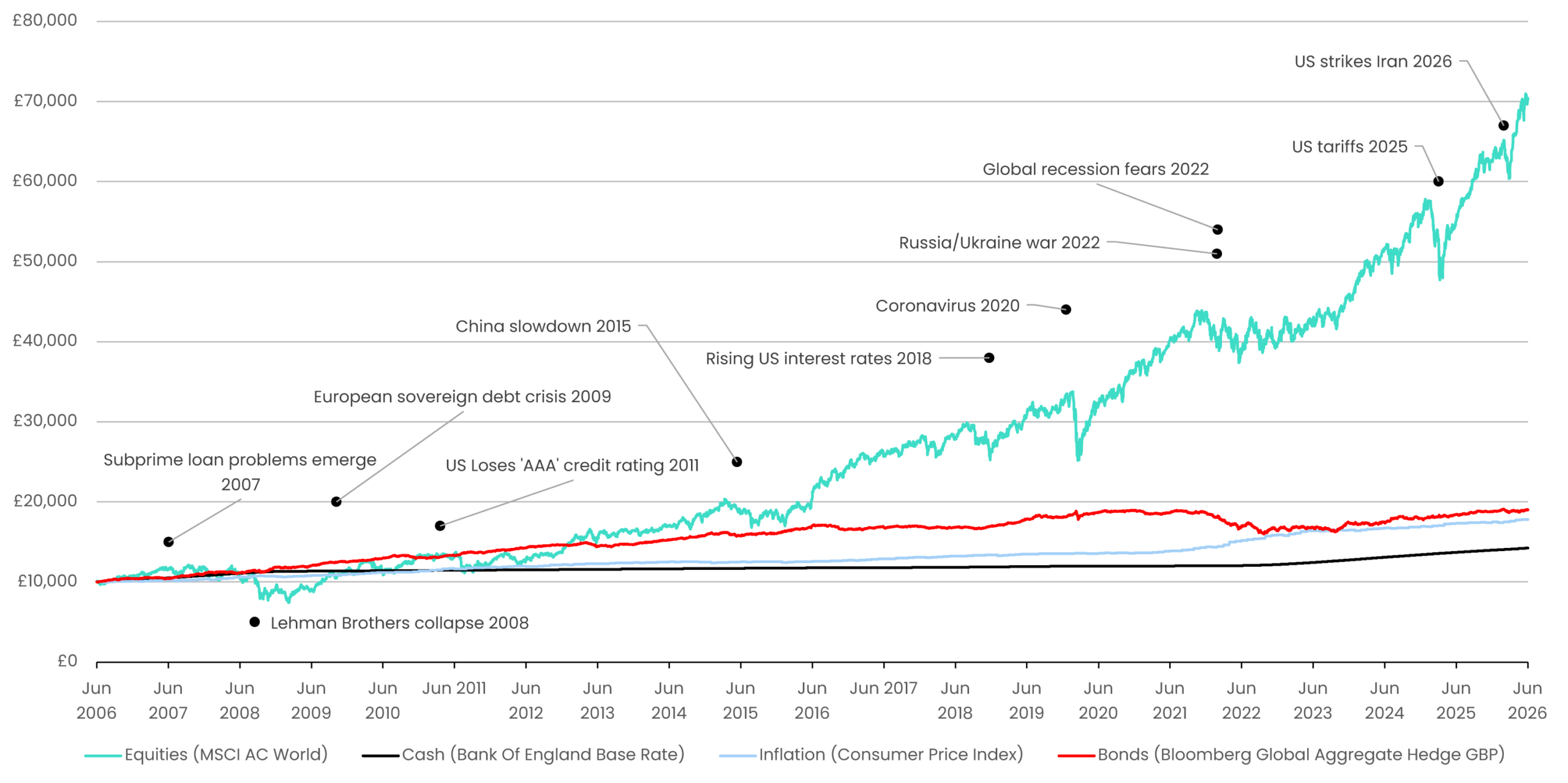
Source: FE fund info – data to 30/06/2026
Past performance is not indicative of future performance.
Please note it is not possible to invest directly into the indices shown and the figures shown do not take into account any charges applicable to the appropriate investment wrapper or any relevant tax charges.
Looking at headlines from over recent years, one might be forgiven for assuming investors have had a tough time. As Preksha says: “There will always be some volatility in the market. This year, it’s the Middle East conflict. Last year we had tariffs. 2022 saw an inflationary shock. In 2020 it was Covid. Yet over the course of these years, overall markets delivered great returns. In fact, in the last couple of years, we’ve seen double digit equity returns, much higher than historical averages.”
Preparation
It’s important to bear in mind that, at some point, equity markets may correct again. When this will happen, and what will cause a slowdown is nearly impossible to predict. However, it is crucial to maintain resilience in portfolios; instead of reacting after any market event, to prepare portfolios to sustain the impact.
This includes ensuring a portfolio features the right level of risk. So, for example, someone in their 20s should usually be investing in a different portfolio compared to someone in their 60s.
“Generally, there is always a layer of volatility within markets that every portfolio is vulnerable to. But portfolios should be constructed to cope with a certain amount of market volatility.” says Preksha.
Key to this is diversification. Blending different asset classes with different risk profiles can result in very different market scenarios. Equities have higher potential growth but are more likely to see big swings (both up and down). In contrast, bonds provide a more stable and predictable return.
However, no asset is entirely risk free, and you can always lose money. Cash, for example, is especially at risk of losing purchasing power over time, particularly in periods of higher inflation.
While investments have historically provided higher returns than cash over long-term periods, you could still get back less than you invest.
Take the long road
Ultimately, what happens with the Iran conflict, and the long-lasting impact, remain uncertain. For example, how long will the Strait of Hormuz be closed, or what any eventual peace deal will look like. However, over the long run, such global events tend to become less important to ultimate investment returns.
For this reason, Preksha concludes: “The best approach is to invest with a long-term mindset and stick to core investment principles. This raises the chance of seeing positive returns on your investment journey on a consistent basis.”
The value of an investment with St. James’s Place will be directly linked to the performance of the funds you select, and the value can therefore go down as well as up. You may get back less than you invested.
Certain information contained herein, including without limitation text, data, graphs, charts (collectively, the “Information”) is the copyrighted, trade secret, trademarked and/or proprietary property of MSCI Inc. or its subsidiaries (collectively, “MSCI”), or MSCI’s licensors, direct or indirect suppliers or any third party involved in making or compiling any Information (collectively, with MSCI, the “Information Providers”), is provided for informational purposes only, and may not be modified, reverse-engineered, reproduced, resold or redisseminated in whole or in part, without prior written consent.
BLOOMBERG®” and the Bloomberg indices listed herein (the “Indices”) are service marks of Bloomberg Finance L.P. and its affiliates, including Bloomberg Index Services Limited (“BISL”), the administrator of the Indices (collectively, “Bloomberg”) and have been licensed for use for certain purposes by the distributor hereof (the “Licensee”).
Bloomberg is not affiliated with Licensee, and Bloomberg does not approve, endorse, review, or recommend the financial products named herein (the “Products”). Bloomberg does not guarantee the timeliness, accuracy, or completeness of any data or information relating to the Products.
SJP Approved 11/08/2026